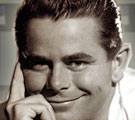




| About Peter Ford
Peter Ford - Son of Glenn Ford and Eleanor Powell
Peter Ford had the good fortune of being the only
child of two of Hollywood's most renowned movie stars, Eleanor
Powell, one of MGM’s greatest musical stars,
and Hollywood's number one box office star of 1958,
Glenn Ford.
At the age of thirty-three, Eleanor Powell gave up
her career as a Hollywood dancer/actress to take on the new,
and according to her, more important role of wife and
mother. At the time of her early retirement, Eleanor was already
a well-known, well-loved performer. Giving up her career
for a life of domestic bliss to be married to a little
known actor by the name of, Glenn Ford, had studio moguls
and fans in an uproar. It wasn't until three years after
their marriage, in 1946, that the public and studio heads
knew who Glenn Ford really was. It was that year that "Gilda" was
released, which starred Glenn and Rita Hayworth. They would
electrify the screen in what was to become a "classic".
Glenn Ford had "overnight" become a major star.
Born in Los Angeles, California on February 5th,
1945, Peter Ford was the child of a marriage made in Hollywood.
He led a childhood of many privileges and opportunities
that most children would never experience. Among some
examples, Peter recalls learning to swim, “When I was five
my parents wanted me to learn to swim. A normal activity
for most young children but my parents went about it a
little differently. Instead of enrolling me in swimming
class, they built an Olympic sized swimming pool in our
back yard. Not only did they hire a private swimming instructor
to teach me, but my 'swim coach' turned out to be an old
friend of Mother's from her early days in show business,
Johnny Weissmuller." It was the same story with
tennis, for tennis lessons he was packed off to the Beverly
Hills Hotel to play with Pancho Segora, for golf - Peter
practiced in the backyard with the great Ben Hogan who
was also preparing his father to play him in the film,
Follow the Sun.
It was certainly not the “average life” and
Glenn Ford made a point to ensure his son, Peter, would
not be overindulged to the point of being a spoiled brat.
A common term labeled on many of Hollywood’s children.
The off-spring of a father who was a plumber or shop
assistant/stay at home Mother would grow up with just the regular
family friends coming to visit the family home. This was the
same with Peter, however his “family friends” who’d
visit frequently were quite different. "Because of
my Mother’s earlier Broadway background, I met many
luminaries of the stage and screen at a very young age.
Eddie Cantor and Sophie Tucker were regular visitors, as
was Al Jolson, who my Mother once briefly dated. Jimmy
Stewart and Rita Hayworth would visit often. One clear
memory is of going to Pickfair, the social 'place to be'
in those days. It was the residence of Mary Pickford and
Douglas Fairbanks. I remember sitting on Mary Pickford's
knee as she told me stories. We were only a few houses
away from Pickfair so it wasn’t far from home.” Fred
Astaire lived up the street and Charlie Chaplin was his
next door neighbor. Peter recalls, "I will never forget
the night that Charlie Chaplin, rushing down the street
in his car, hit my beloved German Shepard, Bill. I suffered
a lot of trauma over my dog’s death. Any child would." The
fact is, as a child, Peter didn't know these people were
famous. It was really no different for him to have Clark
Gable, Bette Davis or Barbara Stanwyck sitting at his dinner
table. James Mason, another neighbor, often was his baby
sitter when his parents were out for the evening. Pearl
Bailey is my God Mother and Bill “Bojangles” Robinson
is my God Father. "My parents were entertainers
and their friends were entertainers. It is amusing to
think back on, now that I realize how significant these
people were.
"I remember that nearly every weekend Mom, Dad
and I would be poising for pictures that would accompany
movie magazine stories that were being written at the time. As
the only child of these two famous parents I was often
needed for publicity sessions. Today, my children get
a kick of seeing their Dad as a child in all these early
publications."
Peter's parents were married in October of 1943. After
the marriage Eleanor gave up her career to be a housewife
and Mother. She never really returned to films, the family
was more important to her than her career. "After
'Gilda' was released and my Father was now considered “a star”,
my parents wanted to buy their own home. My Father was under contract to Harry
Cohn at Columbia Studios. Mr. Cohn was not known for his generosity, so Dad,
working under his old weekly contract, couldn't afford it. Mom stepped in and
went to London and appeared at the Palladium where she earned enough money
for the down payment on the house. They purchased a huge twenty-two room home
on Cove Way, Beverly Hills." The previous owner had been Max Steiner;
who composed and conducted the music for countless films, Gone with the Wind,
The Treasure of Sierra Madre, and Casablanca to name just a few.
In 1952 Eleanor created and hosted a religious television
show called, “Faith of our Children”. It was
the first weekly religious show west of the Rockies. Peter
appeared as a member of the Sunday school class for the
four years the show aired. “Faith of our Children” won
five local Emmys. Some of Hollywood's biggest stars at
the time were guests on the program.
In a foot note to Rock and Roll history, Peter was
directly responsible for the Bill Haley and his Comet’s song “Rock
Around the Clock” appearing as the theme song of
his father’s film, Blackboard Jungle in 1955. This
song was called the anthem of rock and roll by Dick Clark
and ushered in the rock and roll revolution that was
to significantly shape our American culture.
In a Hollywood sense, sixteen years of marriage is
a long-term commitment. That was the length of time it took before
divorce was mentioned in the Ford household and in
1959, at the age of fourteen, Peter’s secure world had
crumbled around him. He recalls those times clearly.
His father didn’t want his son to become another
Hollywood brat, and because of that fact he often went
beyond what was necessary to instill a sense of discipline
and responsibility. "There were many times when
my friends wanted to play and Dad would insist I spend
the weekend chopping wood and doing other chores, I was
only excused if I was before the camera doing publicity.
Conversely, my Mother would indulge me by buying me ice
creams and milkshakes to compensate for Dad's strictness.
It was a battle between the two of them and I was the
chess piece stuck in the middle. It became more strategic
as the divorce grew closer. I'll tell you this, divorce
can be very hard on children, and it was on me.
I was not handed a new car or a wads of money for
the asking. I probably felt sorry for myself at the time,
but now I appreciate that it’s made me a better person
for not getting the 'easy ride.' Sadly, many of my 'show
biz' peers are today, bitter, lonely or dead for lack
of good parenting."
Some of his fondest memories are of his father and
him building projects together. "We had a workshop with
tools that he taught me to use. Among other things, we
created a wonderful fort, with two bunk beds and even a
WW II anti aircraft gun and turret on the roof, accessed
by a secret trap door. It was the hit of the neighborhood." This
pursuit of woodworking was a passion that most certainly
spilled over into adult life and led Peter to create his
own construction company. "Dad might have been strict,
but I owe him a great deal for some of the talents and
qualities that I have to this day."
There were certain formalities in the Ford household.
Peter remembers, "As a child I would always
have to dress in a shirt and slacks for dinner. Dad
would, without fail, check my hands and fingernails
at dinner to make sure they were clean. They had
better be clean or dinner would wait. Not only did
I make my bed every day, but the quarter that my
father inevitably dropped upon it, needed to bounce
the required two inches. Needless to say, doing my
chores and helping around the house was expected,
and rightly so.
I loved both my parents but at the time of the divorce,
I had to choose where I would be living. I decided to
live with my Mother because she needed me, but that choice cost
me the opportunity to be with my Father for a very long
time. Until the time of the divorce, my parents maintained
separate living areas in the same house. My bedroom was
right in the middle. I remember the lawyers coming and
going and whispering about what would happen to “the
child”, but nothing was ever spoken about it to
me out loud. It was a very stressful time. As much as
my parents parting hurt me, I was glad when the separation
was finalized.
Within days, my mother and I were left alone in a
huge old mansion on a couple of acres of land. It was eerie,
my dad was gone and with him the social life we once
knew. Frank, the gardener, was the only other adult I saw for
awhile at the house. We couldn’t afford to pay anyone
else to help maintain the household. After a few months,
as a matter of survival, mom decided that she would need
to go back to work. But this was not the story that was
given to the press. She took out a large loan against the
house to finance the return of dancing star: “Eleanor
Powell.” She was doing it because of a challenge
from her son.
Over time, she developed an act and took it on the
road. She was a success. At one time she was earning over
twenty-five thousand dollars a week. Not a bad paycheck, and
in the early 1960s it was big money. However, there was a problem.
All the money she made had to be plowed back to maintain
the act. By the time the dancers were paid, the costumes
were cleaned and the traveling costs were calculated,
not to mention everyone insisting on flying first class, there
was a cash flow all right, but it was all going out.
No profit!"
During those years when his mother was on the road,
Peter lived by himself in the big house while he was going
to college. "Dad and I started seeing each other again,
in fact I moved in with him for awhile. I appeared in a
handful of films with him during the late 50s and 60s.
In the mid 1960s my mother retired again, and I moved back
home to help her maintain the old house. Sadly, although
we struggled to keep it, the house had to be sold. We just
couldn’t afford its upkeep. Many nights we would
sit down to a meal of Hamburger helper and beans, we honestly
couldn’t afford anything else. We grew the vegetables
in the yard, that everyone thought were for show, they
were not, we ate them.
I really think mother did her best acting when it
was time to sell the house. She was well prepared, and thinking
back now, it is amusing. Because we couldn’t afford
anyone to help us, on the day of a 'showing' mother and
I would spend all day cleaning. She would purposely make
the real estate broker’s appointments toward the
end of the day in order to give us enough time to make
the place look immaculate. When they eventually showed
up with their clients, hopefully, potential buyers, mother
would always make sure she was outside, lounging in the
sun by the pool. She played the part of the retired movie
star perfectly. She was entirely believable reading a
glamour magazine wearing her dark glasses, and doing
her best Joan Crawford. Who would have believed that
just minutes before she had been furiously cleaning the
toilets, with me following behind with the vacuum and
dust cloth."
As the only child of two actor parents it is a given
that the only child of two people in “the business” would
try his hand at the same profession. Peter did just that.
Peter has worked in nearly two dozen-film projects, both
as an actor and a dialogue director. The first film in
which Father and son both worked on together was “Gilda” where
they used Peter’s photo to represent Johhny Farell
(Glenn’s role in the film) as a child, and later, “The
Americano” which was shot in Brazil in 1954. Peter’s
first speaking role was in The Gazebo in 1959, one of
Glenn's favorite comedies, co-starring Debbie Reynolds.
He also appeared in Pocketful of Miracles, Dear Heart,
Advance to the Rear, Fate is the Hunter and The Rounders,
to name a few
Peter graduated from Chadwick High School in Palos
Verdes, California in 1962. He received Associates of Arts degree
from Santa Monica College in 1966 while pursuing a career
as an actor and singer. Under contract to Capitol Records,
Peter was being mentored by the legendary, Nat King Cole.
Later, when recording for Phillips Records, the release
of his single, “Blue Ribbons”, resulted in
appearances on many teen music television shows including,
American Bandstand, Hullabaloo and Ninth Street West.
Later, Peter was also under contract as a singer at MGM
records
He eventually formed his own group, The Creations, and
they appeared in various local clubs in and around the
Los Angeles area, as well as the Whiskey A Go Go in San
Francisco and the El Cortez Club in Las Vegas.
In the summer of 1966, Peter and his group were scheduled
to appear in San Diego, on the bill with pop music stars,
Peter and Gordon. It was a major break but the unimaginable
happened, Peter was struck with crippling arthritis.
Within weeks he was totally bedridden. He was forced to give
up everything he had worked so hard to gain. Just when it
was within reach, it was taken away. Peter remembers
back to those days. “I was told I’d most likely
be in a wheelchair for the rest of my life. I remember
being in such excruciating pain. Some mornings I would
have to crawl from room to room just to get around. Most
doctors told me it was a hopeless case, I would be crippled
from this disease, and I would never walk again. I refused
to believe it and went about my own health regime to mend
my broken body. I gave up all red meat, liquor and most
other things considered “bad for you” and
eventually I was able to stand then walk with a cane.
It was agonizing to make such an effort but I had to,
I refused to give in, there was too much at stake."
Peter went back to College. His singing career now virtually
ended before it had really began, but there was no other
choice but to go back to school. He was accepted at the
University of Southern California. Throughout those two
years at U.S.C Peter had to walk with a cane and crutches.
It was diagnosed that he would need them his entire life,
and would never walk unassisted again.
It was at U.S.C that he met his future wife, Lynda Gundersen.
Both were English majors. In 1968, Peter graduated, cum
laude, with a B.A degree in English. He was accepted to
law school at U.S.C., Lynda went on to receive a Masters
in Education and became an elementary public school teacher.
For Peter, Law school was put on hold, when the summer
of 1968 he was offered a job he couldn’t refuse.
He was asked by actor/producer, George Montgomery
to co-star with Chuck Connors and Ceasar Romero in
a western: The Proud and the Damned. It was to be
filmed in Columbia, South America. Peter, still suffering
from arthritis, took the part. He was only able to
complete the film with massive doses of medication.
But by necessity, Peter felt he had to try and make
a steady and reliable living by what he knew best,
carpentry. To try and work full time in the movie
business was too physically demanding. He started
doing small jobs for family and friends. It would
soon be the start of a successful building company.
Peter and Lynda were married in his Father’s home
in December 1970. Rita Hayworth, now Glenn's next door
neighbor, was the guest of honor. Peter and Lynda's first
home was a small rented apartment in West Hollywood. It
was during this time that Peter, between building commissions,
began working at Twentieth Century Fox as a dialogue director.
His first project was The Mephisto Waltz starring Alan
Alda and Jacqueline Bisset. Peter’s association at
Fox afforded him other opportunities, including a recurring
role as an actor on “The New Perry Mason” television
show.
While at Fox in 1972, he was invited to play a supporting
role in his Father’s new T.V series, “Cade’s
County.” The series ran for one year on CBS. Peter
appeared as the forensic deputy, Peter Odom, in nearly
every one of the twenty-six episodes.
All through the filming, Peter was still suffering
terribly from the crippling arthritis. His strict diet continued
medication and intense physical therapy had only
become bearable. One night, after yet another heavy does of
steroids, he asked his Mother to help him, to pray from the
release from the grip of pain in which he had been living.
She did just that, and the next day, he was, for the first
time in years, without any pain. His doctor was amazed,
Peter was amazed. All hope had been given up that
he’d
ever be completely well and all of a sudden this
miracle had occurred. Soon, Peter stopped all medication. Over
three decades later, Peter remains completely free
of the once crippling illness.
After Cade’s County had ended, Peter was asked to
join the LA. County Sheriff’s Department as a Reserve
Deputy. He had played a sheriff in the forensic lab in
the series and had been trained for his role by a technical
advisor from the Sheriff’s Department. Peter, who
only months before was nearly disabled, was able to join
the force in 1973. He eventually reached the rank of
Lieutenant, and retired in 1996 after twenty-two years
of public service.
During the mid seventies, Peter continued to work
in the film industry. It was in a nearly fatal airplane accident
(in a scene with actor, James Wood) while filming an
episode of a television series at the time, “Barnaby Jones”,
that led him away from acting and back to his love, building
and working with his hands. Before he stopped acting, Peter
appeared in eight films with his Father, he had several
roles in television shows, a singing career and had even
appeared in a play, “Member of the Wedding” with
Ethel Waters. Peter, not only had the opportunity of
working at every major motion picture studio, but, as
was mentioned earlier, he also had a speaking role in
Frank Capra's last film, Pocketful of Miracles.
With Lynda teaching school and now also working in films,
they both remodeled their first home. Their funds were
scarce, so they did all the work themselves. Peter did
the construction, Lynda sewed the drapes and decorated,
and together they painted the rooms. Their first child,
Aubrey Newton Ford, joined the family in January 1977.
They sold their home and made enough profit to purchase
another and remodel that one as well. Eventually it became
a pattern. Peter and Lynda decided to put all their energies
into buying, remodeling and selling homes for a living.
Before they stopped, and moved in to care for Peter's father,
they renovated and sold seven homes.
Peter’s first major home building commission was
for Walter and Rita Coblenz, producer of All the President’s
Men and The Onion Field. He took a partner into his company
and the Blackoak Development Company was born. Peter
went on to build and remodel homes for many well known
clients producer, Steve Tisch, actress, Mary Kay Place,
producer, Jerry Belson, super agent, Jeff Berg, Don Simpson,
producer of Top Gun and Beverly Hills Cop, Chuck Shyer
and Nancy Meyers who wrote Private Benjamin, actress
Jo Beth Williams, health guru Richard Simmons, actress
Sally Kellerman and Blake Edwards and Julie Andrews.
In August 1984, Ryan Welsie Ford was born and their daughter,
Eleanor Powell Ford joined the family in July of 1988.
In 1989 Peter took over the company and operated it as
a sole proprietorship until his retirement from building
in 1996.
Peter’s company, Blackoak/Ford, was a respected
custom residential construction firm working in Los Angeles.
His work has been published in the most prestigious architectural
magazines throughout the world. The Schnabel House, designed
by noted architect, Frank Gehry, was voted by the New York
Times as one of the “Ten Contemporary American
Homes that matter most to Architects.”
Today, Peter and Lynda support many charitable causes.
Peter also serves as a member of the board of trustees
of The Americanism League. He’s a student and
collector of Native American material culture, an
avid reader, collects movie memorabilia from Hollywood's
Golden Age, and maintains The Glenn Ford and Eleanor
Powell Library and Archives. As a writer, he also
has had numerous articles published. His collection
of the personally inscribed photos to him, which
he started collecting as a child, is extensive (see
www.peterford.com ). One expert who has seen his
autographed photos said it was one of the most comprehensive
collections he had ever seen. Peter had the rare
opportunity of personally knowing most of the greatest
figures of stage and screen from the bygone days.
In addition, he is a public speaker dealing with
issues of Americanism and patriotism, as well as
recalling his adventures as a participant in that
starry cosmos known as Hollywood.
Peter’s various interests led him to KIEV 870
AM radio, where for nearly three years he hosted a popular
weekly nighttime political talk show. The station
was sold in 1998, and he left the air.
Peter has run twice for non partisan elected office. He
received ten thousand votes in his first attempt and thirty
thousand in the next, but both were unsuccessful. The outcome
of these two efforts sparked considerable interest by many
people who have encouraged Peter to seek partisan office
in the future.
Peter is now retired, but remains active in many
endeavors, from sitting on Boards of Directors, helping local charities
and pursuing his various hobbies. He is currently writing
a book about his Father, and another about his unique
place growing up in Hollywood's Golden Age. Peter’s mother,
Eleanor Powell, died in 1982. Today, Peter and his wife,
Lynda reside in Beverly Hills, California.
It does certainly seem Peter Ford not only survived being one of child of Hollywood,
but made his own way in the world, built a business, had a family and lived
through the normal ups and downs that all of us endure from time to time. Although,
through it all, his success was not because he was the son of two movie star
parents; it was simply because he was, Peter Ford.
Go to Peterford.com
|